Five Takeaways: How Verizon turns AI workflows into corporate communications advantages

Verizon, the top-ranked US company in the Bowen Craggs Corporate Digital Communications Index, is treating AI less as a content generator, and more as an operational tool for corporate communications.
At a recent subscriber event, Diana D’Achille, Senior Manager of Corporate Communications at Verizon, shared how her team is using AI for editorial workflows, CMS strategy and governance, while keeping human judgement firmly in the loop.
Her message to communicators is simple: "The true power of AI isn't in drafting copy - it’s in eliminating operational friction so teams can focus on high-stakes strategy and maintaining an authentic corporate narrative."
So, how are communicators practically using AI in their day-to-day work, beyond general queries?
D'Achille shared a few tips along the way from content governance to web design, and the checks and balances of using AI as a corporate communicator.

Verizon's corporate homepage
1 Start small: automate the work that keeps repeating
Rather than attempting wholesale transformation, D'Achille recommends identifying repetitive tasks first: “My best advice for anyone who wants to get into AI is start small, identify things that are tedious, maybe something you’re doing every week. And then you can turn those into AI workflows.”
Verizon uses Google's Gemini Gems to cross check new web content against style and brand guidelines before publishing. The tool reviews copy and imagery against web design standards, best practices, language guidance and brand rules, helping the team catch details that the human eye may have missed.
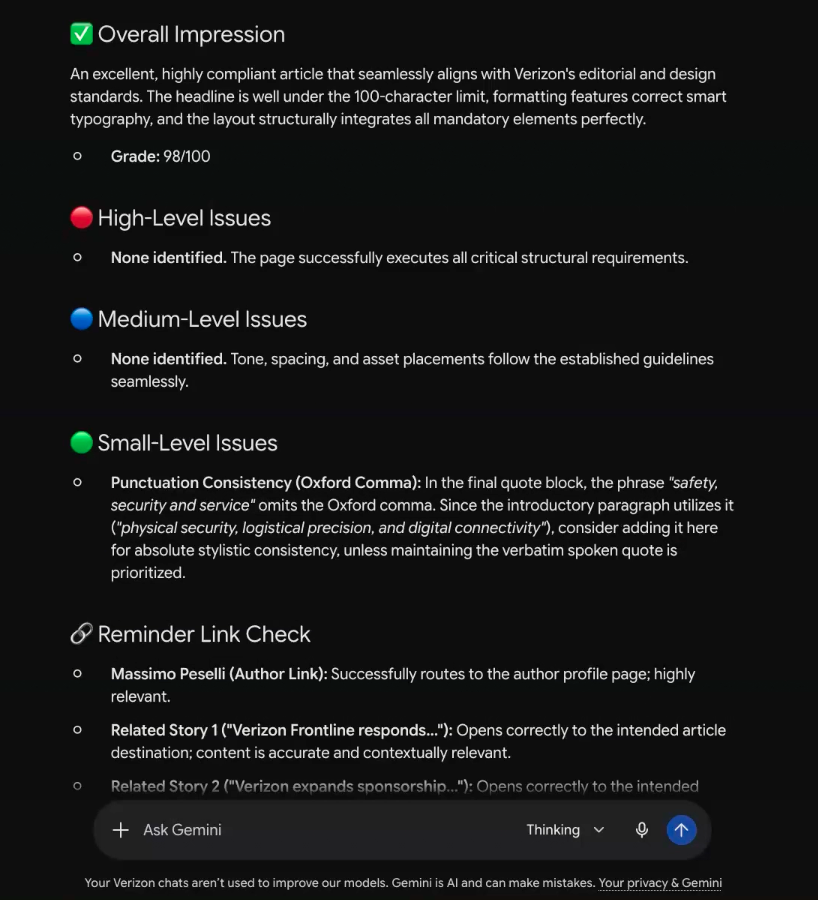
Another practical example using a Gemini Gem involves creating a “Changelog tracker” for recent updates recorded in one place, which is used from leadership to teams outside of communications.
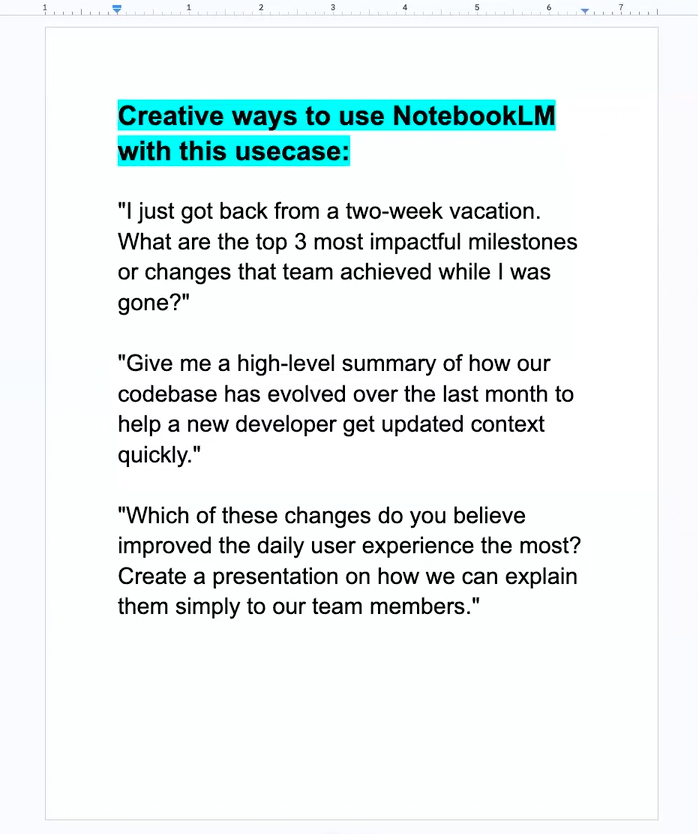
The tool summarises any updates and can sync with NotebookLM for questions related to updates or timelines, such as, “I just got back from a two-week vacation. What are the most important milestones I missed?”.
This shifts AI from content creation to governance – carrying lower risk than using AI to create content, while also delivering immediate productivity gains.
2 Build an internal knowledge hub
Google's NotebookLM serves as a secure, centralised knowledge hub for internal teams, given that it does not train its AI models on your uploaded documents. D'Achille shared how the Verizon team use NotebookLM to facilitate their CMS migration.
“[With NotebookLM], I’ve created transcripts from past meetings with my team where we’ve discussed a new functionality…taking one-hour, two-hour long conversations, put in the transcript, and then you’ve built a knowledge hub.”
Onboarding information is also streamlined for consistency, as a one-stop shop via NotebookLM.
3 The all-important human touch
While AI can identify character limits, check content against brand guidelines, or surface stock images, it cannot replace human judgment. D'Achille emphasised the importance of protecting your organisation’s voice through human touch to protect authenticity and corporate reputation.
“You want to visit Verizon and feel like you’re communicating with humans, real people, not feel like it’s a robot.”
This is where human oversight is critical to producing distinctive, credible, and recognisably human content for your audiences, both for human and AI systems who favour these traits.
4 Inspiration to “work smarter, not harder”
Using AI in the initial brainstorm and research phases can help refine ideas around messaging and design. D'Achille uses prompts to spark idea flow such as, “Give me additional brilliant ways I may not have considered,” from social media posts to article angles, or web design.
5 Prepare for autonomous agents
Adapting to AI means building systems that support your needs and create efficiencies to focus on the work outside of administrative tasks. D'Achille anticipates autonomous agents to be the standard for monitoring trends and gathering research simultaneously throughout the day to keep processes moving.
However, privacy and security remain key concerns, so as to not train on public models with company information, and to stay within compliance grounds.
Final thoughts
GEO best practices favour unique, distinctive, and credible voices, making human judgment imperative in the content creation process. D'Achille raised a vital point: AI is not replacing expertise or the corporate communications function. Rather, it opens new ways to approach work and frees teams to create authentic digital experiences designed for both humans and machines.
Diana D'Achille’s 4-Pillar AI Communications Strategy
- Workflow Automation
Deploying Gemini Gems to streamline tedious QA processes and accelerate brand alignment reviews. - Knowledge Centralisation
Leveraging NotebookLM to build a secure, zero-training knowledge base to simplify large-scale digital transformations. - Human-in-the-Loop Oversight
Utilising AI as a strategic ideation tool while maintaining strict editorial control to protect brand authenticity. - AI Agent Readiness
Structuring current data and operational workflows to seamlessly integrate future autonomous AI agents.
Bowen Craggs has developed an AI search visibility audit for corporate digital teams, where we assess how your organisation appears across AI-powered search, and provide clear, actionable guidance on how to improve and build long-term authority through your owned channels.
If you would like to learn more, please email Tom at tgolden@bowencraggs.com