The problem with saying something without saying anything

Ed Sheeran has spent most of his career doing a remarkably good job of not upsetting anyone.
That became more difficult this month when he found himself in the middle of an argument about Israel, Palestine, freedom of speech and the removal of Macklemore from his US tour.
Sheeran's response tried to explain why he had deliberately avoided taking a public position. He described the suffering on both sides as a human tragedy, said he had personal views but chose not to share them publicly, and argued that he wanted his music and platform to remain a place of “safety and sanctuary”.
It did not exactly put the issue to bed.
The criticism that followed was interesting because much of it wasn't simply about which position Sheeran had taken. It was about his reluctance to take one publicly at all. His attempt to keep everybody in the room was interpreted by some as trying to have it both ways.
There are many reasons why the circumstances surrounding Ed Sheeran are different from those facing a company. But the communications problem he stumbled into feels very familiar.
Because companies spend an awful lot of time trying to say something without saying anything.
...always being apolitical is a position too.
The statement everyone can agree with
Something happens. People expect a response. The communications machine whirs into action.
“We are deeply concerned.”
“We recognise the complexity of the situation.”
“We remain committed to our values.”
“We are listening to all perspectives.”
None of these sentences is necessarily wrong. That's partly why they appear so often.
The problem is that you can reach the end of 300 carefully approved words without being much clearer on what your company actually thinks than you were at the beginning.
There are understandable reasons for this. Global companies have employees, customers, investors and operations spanning countries, cultures and political beliefs. Not every issue requires a corporate opinion, and there are plenty of occasions when saying nothing is more sensible than desperately inserting yourself into the news cycle.
But always being apolitical is a position too.
If an issue materially affects your company, your employees, your customers or an area in which you claim expertise, perpetual ambiguity starts to look less like careful neutrality and more like an unwillingness to say what you think.
And if you do decide to publish a statement, presumably you have something to say.
A useful corporate point of view should have some relationship to who you are
Having a point of view doesn't mean having an opinion on everything
This distinction matters.
I'm not suggesting every CEO needs to become a political commentator. The corporate world has already produced enough statements about events with only the most tenuous connection to the company issuing them.
A useful corporate point of view should have some relationship to who you are.
A pharmaceutical company should have interesting things to say about healthcare. An energy company should have a view on the energy transition. A technology company developing AI should be able to explain what it believes responsible AI actually looks like.
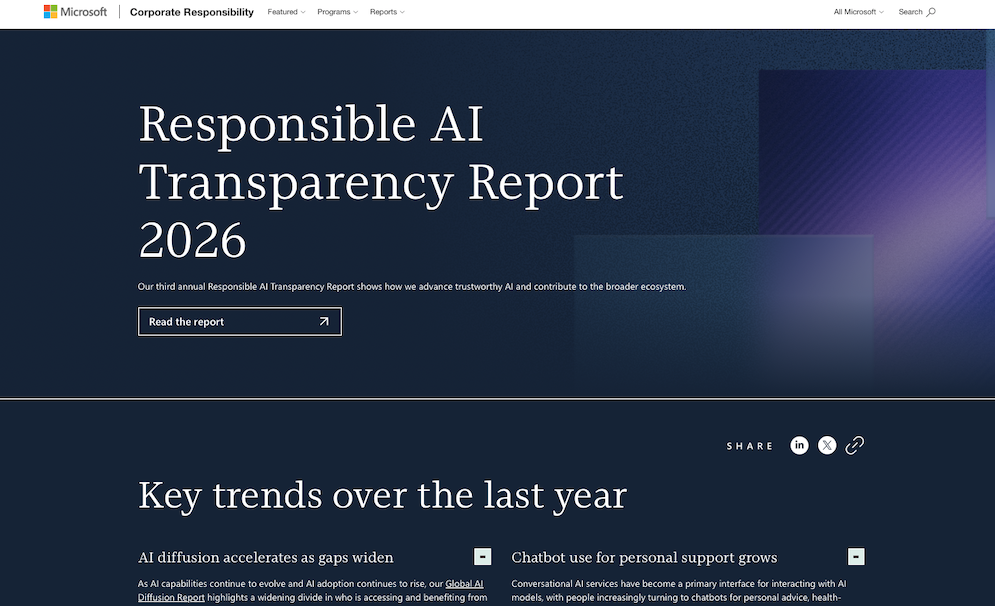
Microsoft, for example, doesn't simply say that responsible AI matters. Its published principles cover areas including fairness, reliability and safety, privacy, transparency and accountability, backed by a Responsible AI Standard and a transparency report explaining how those principles are governed in practice. You may agree or disagree with its approach, but the company provides something concrete to interrogate.
That's the difference between having values and having a point of view.
Sometimes the clearest position is simply: we got this wrong
What happens when people disagree with you?
Of course, the reason generic language is attractive is that specificity creates something for people to disagree with.
Oatly has taken an unusually direct approach to that problem.
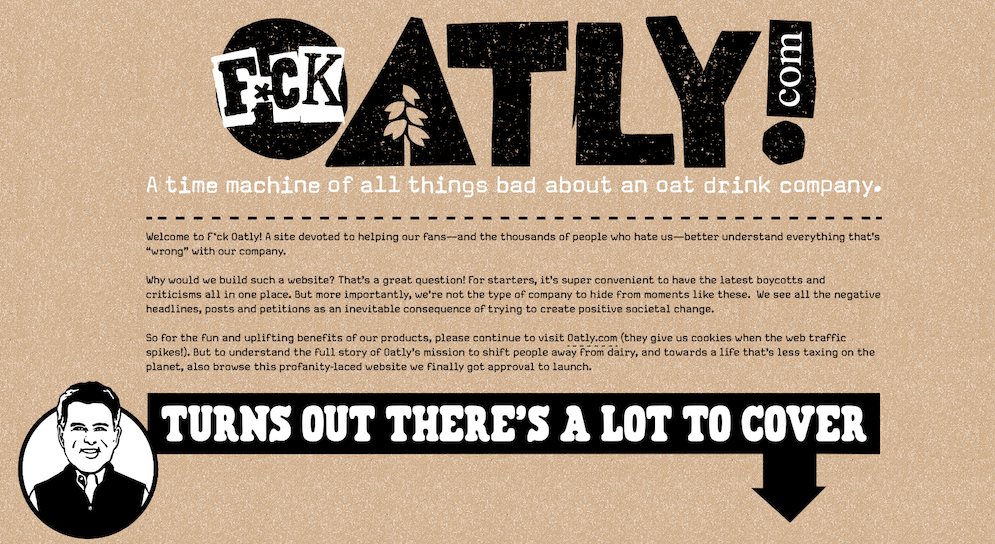
Its wonderfully named FckOatly.com is essentially a repository of things people dislike about Oatly. It collects boycotts, negative headlines and controversies surrounding the company, then explains Oatly's side of them.
There is an important detail here: Oatly doesn't defend everything it has ever done. The company has said the site focuses on decisions it still stands behind; where it thinks it got something wrong, the appropriate response is to admit it.
It's obviously an approach that suits Oatly's particular brand voice better than it would, say, a pharma. But the principle remains.
A corporate website doesn't only need to contain the “appeasing” version of your company. If there is a difficult question people repeatedly ask about you, perhaps the most useful thing you can do is answer it.
And sometimes the clearest position is simply: we got this wrong.
Show your working
A point of view becomes more credible when a company can show what it has done because of it.
It is easy to promote inclusion, innovation, sustainability or responsible business messaging. Almost everybody does.
The more interesting questions are: what focal area did you choose? What’s changed? Where did you invest? What did you stop doing? What trade-off did you make?
Specificity doesn't have to mean provocation. Sometimes it simply means moving from “we believe X is important” to “this is what X means to our company in real life”.
That is a harder sentence to write, but it is also far more useful.
AI can’t source “corporate wallpaper”
There is another reason this matters now.
People increasingly ask AI platforms questions they once might have answered by trawling through a corporate website: What does this company think about AI? Is it serious about sustainability? What is it like as an employer? What has it said about a particular controversy?
AI has to construct those answers from something.
If your contribution consists of generic commitments while journalists, employees, campaigners, Reddit users and everybody else are being considerably more specific, you leave a large gap for third parties to fill.
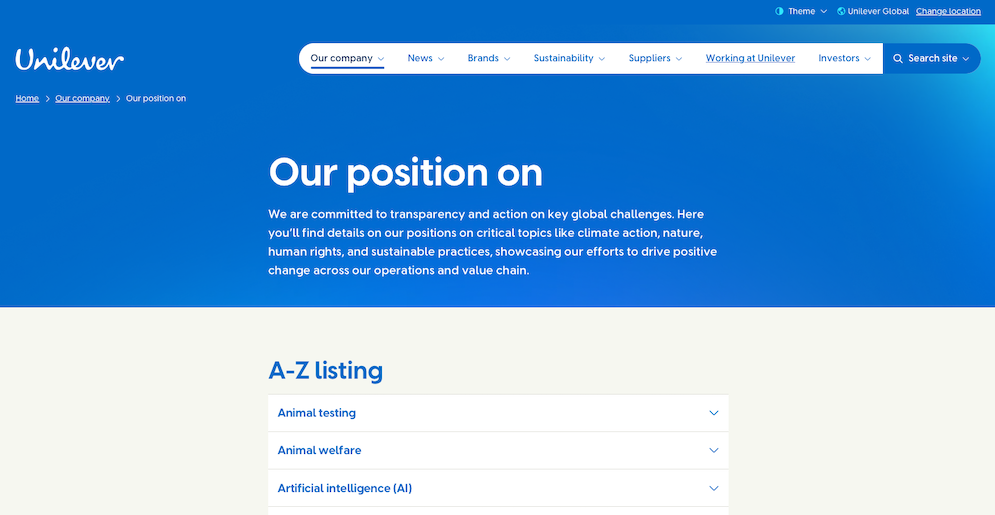
Unilever offers a useful alternative. Its corporate website has an “Our position on” hub that sets out the company's view on issues from AI and climate change to human rights and greenwashing, with links to the policies, targets and actions sitting behind those positions.
It's a simple idea, but an increasingly important one: give people – and AI – somewhere definitive to find out what you actually think.
That doesn't mean writing for robots. It means doing the things good corporate communications should have been doing anyway: answering obvious questions directly, publishing clear positions, attaching names and expertise to them, and providing evidence.
“We are committed to a sustainable future” wasn't especially useful to a human reader, and it isn't much use to an AI agent either.
The worst time to work out what you think is when thousands of people are demanding that you tell them
Know what you think before you're asked
Perhaps that's the part of the Ed Sheeran episode that corporate communicators should pay attention to.
The worst time to work out what you think is when thousands of people are demanding that you tell them.
Many of the difficult questions companies face are entirely predictable. What does responsible use of our technology mean? Where do we draw a line? Which issues genuinely intersect with our business? What happens when our values conflict with a commercial decision? And which subjects simply aren't ours to comment on?
Those conversations can happen before the statement is required.
The answer isn't to have a take on everything. Nor is it to abandon nuance in favour of the loudest possible opinion.
But there is a middle ground between commenting on every controversy and being so relentlessly apolitical that nobody can work out what you stand for.
Ed Sheeran tried to occupy the safest possible ground. For an artist whose career has been built on mass appeal, that's understandable. Companies often want the same thing.
The trouble is, if every statement is designed to give everybody something they can agree with, eventually you may find you've said nothing at all.
If you would like to learn more about how a Bowen Craggs subscription can support you on your reputation management strategy, AI visibility or any other aspect of your corporate digital communications, please reach out to Tom Golden